
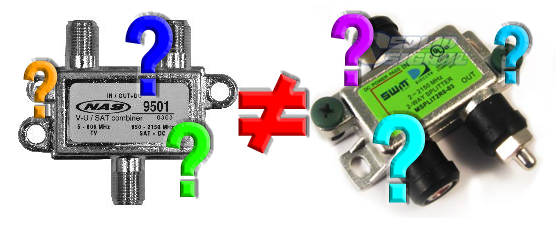
It’s very confusing to know the difference between a splitter, a combiner, a tap, and a diplexer. To make matters worse, some splitters are also combiners, and some diplexers are also combiners. Parts can be active or passive, powered, or unpowered, and without a magnifying glass (or some really good eyesight) they can all look identical.

What is a tap?
Let’s start with a tap. For the most part, do-it-yourselfers will not use taps in their installation. A tap is used in traditional cable systems to make a transition from the master cable that runs through the neighborhood, when a house is wired for cable TV. The master lines are designed for long runs from the cable headend, and a tap adapts the line to be more appropriate for in-home use. Taps can change voltage or change the signal completely. The word “tap” is a very general-purpose term that can apply in many ways.
A do-it-yourselfer would have almost no reason to use a tap. It could be used to steal cable TV from older systems, but modern systems have protections in place to stop this sort of theft. Some people use the term “tap” for any device that changes the signal from one type to another, but this is isn’t really correct. For example, verizon uses a device the call an Optical Network Terminal (ONT) to change from fiber optic cable to coaxial for home use. Even the installers call this a “tap” although there’s a lot more to it.

What is a combiner?
A combiner is a device that takes two signals and puts them on a single cable without any “translation.” Using a combiner is like pouring two liquids into the same glass. You’re not doing anything to make sure that things don’t get all mixed up. If you know what you’re doing, a combiner can work, like mixing lemonade and iced tea. If you don’t, a combiner can create problems, like if you mix lemonade and dish soap. Working with combiners for coaxial cables can have the same problem. A combiner just takes all the signals and mixes them together. Much of the time, the result is a mess. In some cases, signals are meant to be combined and so using a combiner will work.
What is a diplexer?
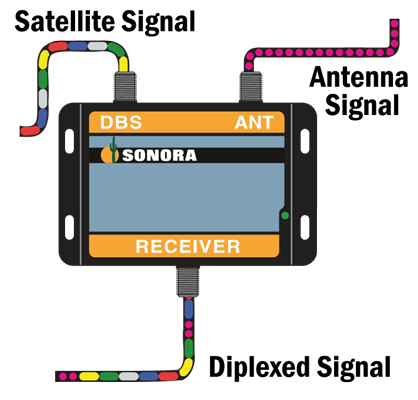
A diplexer is a device designed to take two signals from two different cables and intelligently put them on the same cable. A diplexer is the right thing to use when trying to add an antenna signal to an existing cable. There are many different kinds of diplexers. Passive diplexers are little more than combiners. They take two signals that won’t interfere with each other and put them on the same cable. Active diplexers add power to the line to limit the amount of loss that happens when signals move through a system. Active diplexers can also shift frequencies so that they work together. When a diplexer does this, the diplexer would also be a modulator.
Why do diplexers work?
Diplexers work because cables are a lot more complex than they look. When we look at a cable we see a long line made of wire. In fact, that wire can carry many different frequencies. That’s why you get many channels of the same wire… they all exist in different places on the wire. The FCC makes sure that broadcast signals don’t interfere with each other, and cable and satellite companies make sure their channels are on different frequencies from each other. For the most part, signals from cable or satellite are on different frequencies than over-the-air antennas, so it’s not a problem to diplex them. However, DIRECTV bucks the trend by putting its whole-home and on-demand information in the same place as an antenna signal, which is why you can’t use an antenna and whole-home on the same cable.
What is a splitter?
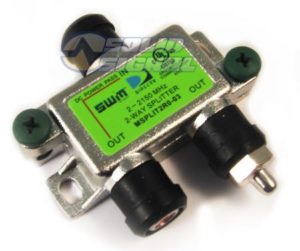
A splitter and a diplexer can look very much alike. They both will have multiple connections on one end and one connection on the other. However, a diplexer takes two signals in and makes one out. A splitter takes one signal in and makes two out.
The most common use of a splitter is to add an additional television to an existing cable. If you have an antenna, you can use a splitter to make that antenna serve more than one television. If you have a cable or satellite system, you might be able to use a splitter to add TV to another room. Most modern systems are designed to use a splitter in this way, but older systems make you run a separate line to each TV from a central switch. Make sure you know if you have a “splittable” system.
Splitting seems like an easy way to add extra outlets, but remember that each time you split a signal you cut its strength in half. Look at this diagram:
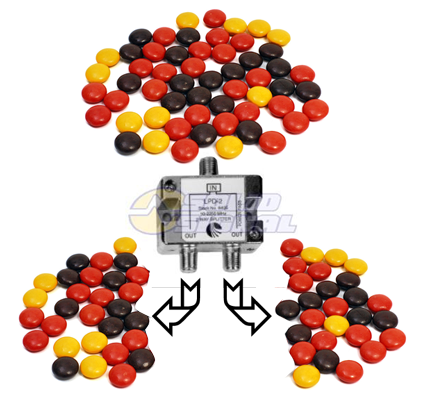
This is what a splitter does. When you split out the signal you only send half as much through each line. It may seem like you have a great quality signal but split it too many times and it won’t get the job done.
What about devices that do more than one thing?
Beware of inexpensive products that promise to be a combination diplexer/splitter. The odds are, they’re not terribly good at either. You’re better off finding a product that does exactly what you need. As you get to more expensive products, it’s more likely that a single device actually has all the electronics to serve both purposes. In the case of modulators, multiswitches, and other specialized high-end devices, diplexing and splitting are part of the basic functions they need in order to operate.




If I have two RF mods that are set to channel 3 & 4 respectively, can I use a simple combiner to combine the output signals from each modulator into one coaxial cable? And then plug that single coaxial cable into the TV and tune the TV to channel 3 to view modulator A and tune to channel 4 to view modulator B?
Thank You
Yes that’s exactly how it’s done all the time. As long as both modulators are putting out a clean signal there should be no problem.
OTA cable coming in (already amplying) and a satellite cable coming in to a Diplexer,OK?
Sorry you can’t diplex OTA and satellite with modern systems.
thank you stuart. so, the only thing to do is to run another individual cable, right?
Right.
I have an indoor aerial for my radio. Currently I have two indoor aerals: FM and DAB and have used a joiner before I plug them into the radio’s aerial socket. Should I be using a diaplexer instead of the ordinary joiner?
I can’t get an external aerial at the moment so…. I am working to improve the signal with what I have got. Could I add a signal booster between aerial cable from the joiner [or diaplexer] to the aerial socket in the radio?
I don’t think you’ll run into problems with the setup you have.
Many thanks No diaplexer?
As long as the antennas are specific to the frequencies you need, a diplexer might not be needed.
Recently found this site and loving it.
Pls i need your advice.
Using coax to run video feed via rca to a tv. But my real aim is to feed 4 tvs via rca. Can i split the rca/av signal with active splitters? If so, what splitter do you suggest pls?
Then again, i got an issue i think would need a diplexer.
I only have space in the wall for one rca cable. But i plan on installing an outdoor antenna for local tv and a sattelite dish for cable tv. Can a diplexer merge both signals? How would i send the antenna signal to tv and catv to its receiver?
Pls respond
Not clear to me. Can I use a diplexer on a Comcast cable and an outdoor antenna?
That depends on your particular system. In most cases yes.