
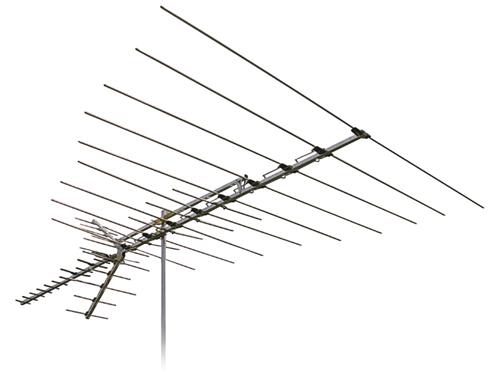
So, a while back, a well-meaning but self-righteous engineer came to us. They recently pointed out to us over social media that our HD8200XL antenna is so large because it contains elements that pick up so-called “VHF-Low” broadcasts. The term “VHF-Low” (you’ll also hear it called “low VHF,” either is fine) refers to broadcasts on channels 2 through 6. He astutely points out that about 95% of people don’t need to pick up these channels.
So let’s get this out in the open…
He’s right.
That said, if we were just starting to do VHF broadcasting for the first time, maybe antennas would be designed differently. When TV broadcasting went digital in the 2000s, a whole new crop of UHF antennas came into being. A lot of stations moved up into the UHF band, and UHF antennas are traditionally smaller than VHF ones, owing to the basic physics of how antennas work. That’s why UHF antennas can be loops, or bowties, or some other compact shape.
At the moment only about 150 channels broadcast on the VHF-Low band and that includes subchannels. That’s a small fraction of the total. So if we were all starting from scratch, antennas would probably be designed to pick up only the actual channels used today, ranging from channel 7 to channel 36. Such an antenna would be quite a bit smaller… our friend the engineer correctly pointed out that the largest part of the antenna is used to pick up the low-numbered channels.
But… we’re not starting from scratch.
Antenna technology is pretty mature, and despite what some companies would have you believe, there’s nothing new or different about picking up the same frequencies that have been in use since before you were born. As I said, the only change is that more stations are on UHF and almost no one is on VHF-low.
So, as a result most antenna designs are variations of ones that have been around for decades. Our own HD8200XL is only the latest variation of the Winegard 8200 line that’s been around since the 1950s. Why mess with success? If you eliminated the VHF-low part of the antenna, you’d have to reengineer it from scratch. That costs money, and the simple fact is that people want to pay less for antennas, not more.
It’s about value
At Solid Signal, we try to make sure we’re providing the best value to our customers. A completely re-engineered antenna could take years to pay for, and it’s not clear if people would actually pay more for an antenna that’s really only a few inches shorter and a few inches narrower. If we could say that such an antenna was actually better than the older one, that would be one thing, but without spending a lot of money on R&D we can’t.
On the other hand, since people really want very compact antennas that excel at UHF, we’ve put a lot of our R&D money into those antennas and we’ve found new and innovative ways to offer great value at a great price. That’s more important than shaving a little bit off a very large antenna. That is, unless you’re a retired engineer.
For the rest of us, finding the best antenna is easy. Shop at Solid Signal for the best selection, and if you would like a professional recommendation, simply fill out this form.



Crazy question: On a mix VHF/UHF you have long VHF elements of different sizes and short UHF elements of the same size. Would you get more UHF gain if you cut the VHF elements to the UHF elements`size?
Potentially yes, if engineered properly. It would act like a 2-bay antenna.
A LOT has changed with the repack. More markets now have stations in VHF-low after they took the money to move to free up UHF frequencies for 4G. And with the power increases most of them were granted giving them coverage areas of 70+ miles, neighboring markets can easily pick them up too with a decent antenna. These are also mostly stations affiliated with the Big 6 and/or PBS. Digging through the stats of the 210 DMAs, 46 have at least 1 full power station in VHF-Low, including 6 of the Top 10 DMAs in the Country. Just those 6 DMAs in the top 10 alone account for 20.323% of US homes, so that 95% number he claims doesn’t need VHF-Low is way off.
If you take into account the LPTV stations, many of which have programming from popular diginets like MeTV, Retro, Cozi, H&I and others, that’s 344 licensed signals across the country now broadcasting in VHF-Low, a number that has grown in recent years after many of the LPTV stations were displaced from UHF and VHF-Hi during the repack. And with the 3 kW power limitation for low power VHF stations, it WILL take a decent VHF-low capable antenna to get reliable reception of these stations. When you bring those LPTV stations into it, 20 of the Top 25 DMAs have stations in Low-VHF, so in other words, he’s NOT right when he claims “95% of people don’t need to pick up these channels”.