
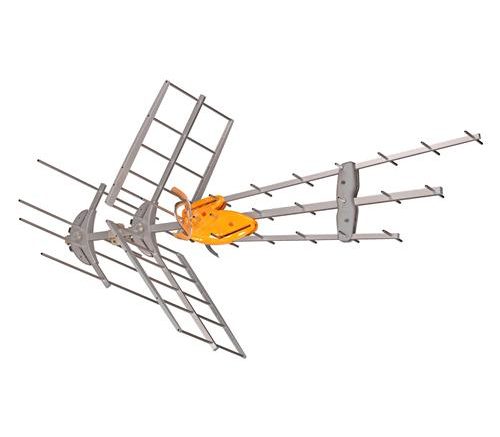
Are your locals coming from two different directions? Are you stuck in the middle? It’s a common problem. To solve it, put up two antennas and combine the signals!
It’s easy. All you need is:
Any combiner like this one: Winegard SP 2052 2 Way Splitter for VHF UHF FM HD 40-2050 MHz (SP-2052) from Solid Signal)
We also recommend an antenna amplifier like this one: Channel Master Titan 2 High-Gain UHF VHF TV Antenna Preamplifier (CM-7777) from Solid Signal to make sure the signal is as strong as it can be.
Another option, if you have one VHF and one UHF antenna is this Televes combination combiner and amplifier: Televes TV Antenna Pre-Amplifier Combiner 2-Input Mast-Mounted (536040) from Solid Signal
Connect the two antennas to the combiner using equal length cables. This will help avoid phase problems. Note, it is possible that both antennas could pick up the same signal and create interference that could actually make interference worse. Aim carefully to try to avoid that.
Then, run a cable to the splitter that comes with the amplifier. The power injector should go in the right side of the splitter, so power can flow though properly. Run a cable from the left side to your television.
Confused? Here’s a diagram. (Downloadable version here)



I have the 536041 Televes 3 input combiner /amp and need to connect a Televes DAT790 LR Mix UHF VHF Long Range Antenna (149881) to use both VHF and UHF and a HD8200XL for VHF and UHF in another direction. Is this possible with this amp? If not, is it possible if the HD8200XL is used for VHF only but still use the Televes DAT790 LR for UHF and VHF?
Thanks
This amplifier will combine two UHF and one VHF antenna, so I’m not sure it would work in this specific case. You could use an external combiner like this one: https://www.solidsignal.com/pview.asp?p=cp2532 and feed both into the UHF/VHF port on the Televes amp. You would still get LTE filtering but you’d give up a little bit of signal and add a little bit of noise.
Using equal lengths of coax to join two antennas may not work. The extra distance one signal has to travel to get to the antenna furthest from the signal source must be taken into account. If you know what the actual signal strength is, I would favor the weaker signal over the stronger signal. Try and measure the actual distance between the driven elements of the two antennas. This may be tricky. Then if you know the frequency of the stronger signal, calculate the part of the wavelength the signal had to travel using the formula Wavelength x frequency = speed of light. Cut the second coax to be a little longer to compensate for the extra distance the signal had to travel and it can be done so that the two signals arrive at the amplifier 180 degrees out of phase and so they will cancel out to a certain extent. And now the hard part! If you can measure the signals from your weaker grouping of stations, comparing them with the signal levels from the other antenna. If the difference between the levels is 20 dB or so, then you needn’t worry about unwanted canceling. Wow! I went through all of this not because I thought that most people would have access to a field strength meter, nor would they be able to figure all of this out, it’s not that easy. I did this to illustrate why connecting up two antennas pointing in two directions can be tricky!
With that in mind, I left out some minor details, such as that the speed of light (and hence, TV signals) are slowed down slightly in air vs. free space- about 5%.
That’s crazy. You do not want to use different length cables. Always use two same length cables. If one antenna is 5 foot from amp and other is 25 feet away you would use 25 feet for both antennas.
You need to keep the signals in phase PERIOD. Besides the fact there is no way you are going to calculate the difference in 20 foot of light travel for a specific frequency and then be able to calculate it well enough nor be able to measure how much to cut off a cable. You can’t measure millionths or billions of an inch or nor could you possibly re crimp it perfectly as said cut length. Not only that but TV is wideband.
Try to cut something to a specific frequency like this is a fools errand. Even if possible if you cut it for channel 14 at 408 MHz you will screw up channel 36 at 608 MHz (assuming even possible).
If you have good directional antennas pointed in two different directions you may be fine just using a simple splitter/combiner. A good splitter will be 3.5 db loss for splitting a signal out to 2 coax cables. It’s splitting the signal in half (minus loss) to each coax. Half expressed in dB is 3 dB. If you use the splitter reversed feeding two antennas in with one coming out it’s just 0.5 dB loss. That’s the simplest/cheapest thing to try first.
That is not true. You can cite all of that mumbo jumbo (Wavelength x frequency = speed of light) all you want, but anyone who has actual experience with antenna system design will tell you that both pieces of cable MUST be the same length to prevent the signals from being out of phase.
Hatterasman, not mumbo jumbo. While I do not even remember posting my comment two years ago now, I stand by it. In this instance, I was talking about 2 antennas pointing in 2 different directions, but receiving the same channel. And this is assuming that they are mounted on the same mast. So, by definition, the driven elements are different lengths from the transmitter. (A half wavelength of said signal at 500 MHz. is ABOUT 11 inches and so not a millionth of an inch as Carlo has stated). So, here is an example: Putting one antenna ABOUT 11 inches further away from the transmitter than the other one, using two pieces of coax that are the same length will effectively cancel out the two signals because they will be 180 degrees out of phase. Hatterasman, your comments about are TRUE, but only when talking about 2 antennas pointed in the same direction. As soon as you start to combine two antennas pointing in two different directions, and receiving somewhat similar groups of channels, you start to get into complex issues regarding how much out of phase each channel is coming from one antenna relative to the other antenna. This is not MUMBO JUMBO.
Agree. Every time I combine two antennas I use cables of equal length.
Have Question Needs Help With Vhf Tv Reception Most Folks On Web Talk More About Uhf For Me My Fav Tv Stations Vhf ch 8-11 on 180 & 198Mhz I Likes Try Combined The #2 x 150 mile Amplified Hd Tv Antennas On The Vary Same 60ft Pole it used Hold My Old CB 10m Antenna Now Going To Be My Ota Tv Mast I Just Needs Know Proper Gap The Spacing Between Two Hd Antennas So Get Little Interference & RG-6 Same Cut Oal. Length or One Cable Shorter Than Other My Vhf Station 45+ Miles West My Local Stuff is 16Mile North Uhf 540-590 Mhz I Get Easy Home Made 8-Bay Vee-Antenna My Issue Try Get One VHF Station tv Channel Scan Not found I’m Located on top Nice 1800+ feet Hill I Own 35 acres 90% Woods Has No Tall Buildings Trees or No Over head Wires There All Underground Try Get Best Set up So do away $77 bill Dish-tv Reading Folks Using Two Antennas I’m Just Not Finding Where They got There Info I Learn in Life Comes these Gadgets It’s Not 100% Correct End up It’s Not Going To Work On Ur Favor Why Asking B4 Waste My $$ & Time
The spacing between antennas doesn’t matter much honestly.
I have a Televes Ellipse Mix and a Clearstream Max V antennas connected to a Televes 560483 dual input preamp.
The preamp has a switch for power pass through. One switch controls pass through for the two ports.
With the switch off, the Clearstream antenna works fine. The Televes (in passive mode) picks up channels only at night or early in the morning. The signals are weak from about 39 miles away.
If I turn on the pass through on the preamp, the Televes picks up channels fine (any time of day), but I loose channels on the Clearstream.
The channel I want to pick up with the Televes is RF channel 30. With the pass through on, I loose RF channels 23 and 29 on the Clearstream.
The channels picked up by the Clearstream are already strong enough, why are you connecting it to a preamp? Sounds like that may be overdriving channels 23 and 29.
Try connecting the antennas via a splitter/combiner, having only the Televes go through the preamp.
I have the Televes antenna pointed to the south and the Clearstream pointed to the north on the same mast. The Clearstream picks up channels well, but only when the preamp is on.
The preamp has a switch to pass through voltage. What I meant by switch off is when the preamp is not passing through voltage to the Televes built in amp the Clearstream works fine. When I turn the switch on to allow voltage to pass through to the Televes built in amp it cancels channels on my Clearstream.
I did not explain that well in my question. I tried a splitter with pass through on all ports today and it did not work.
So you have two preamps, one connected to both and another built in to the Televes??? That sounds like big time overkill for channels 39 miles away unless you have problem terrain. I pick up channels 50 miles away at 85-90%, and ones in around 40 miles at 100%, without any amplification at all.
So maybe try it the other way around, with the splitter bypassing the preamp on the Televes side and going through it for the Clearstream?