New Ronard “Ultra Heavy Duty” satellite dish mounts now available
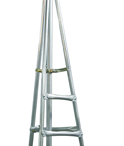
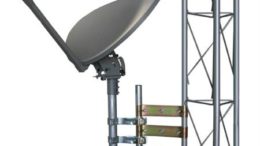
Seven new Ronard satellite dish mount models are now available for purchase. The new models are labeled as a heavier constructed set of tri-pod type mounts more suitable for installations invovling the newer, larger, heavier DIRECTV and Dish Network satellite dishes. Several variations include options for mounting on flat surfaces, peak, and/or slanted roof applications. While designed for heavier dishes, the RON1009 and RON5009 mounts can also be used for the smaller 18″ standard dishes. Ronard Model Overview: RON1101 - 5 Foot Satellite Tripod that supports up to 2 Inch O.D. Mast, for slanted peeak or flat roofs RON1009 - 3 Foot Satellite Tripod with 5 Foot Mast, Supports 1.66 O.D. Dishes on flat roof RON2009 - Same as RON1009, but equiped for peaked, or slanted roofs. RON3009 - 3 Foot Satellite Tripod with 42 Inch Mast for Slim Line, AT9 (AU9-S) and Super Dish for flat roof RON4009 - Same as RON3009 but for slanted, peaked, or flat roof RON5009 - 17 Inch Satellite Tripod with 30 Inch Mast for standard 1.66 O.D. Dishes on slanted, peak or flat roofs RON6009 - Same as RON5009 but accepts the Slim Line, AT9 (AU9-S) and Super Dish.
Tuesday ~ March 03, 2007 by SolidSignal_MikePosted in New Products| No Comments
“World’s Strongest Tripod” for the DIRECTV AU9-S Slim Line and Dish Network Dish1000
We have been working with Ronard Industries to produce a tripod mount strong enough for the Slim Line and AT9 Dishes from DIRECTV. Thursday I went to our warehouse to check out the prototypes that arrived from Ronard. I was surprised to see they sent nine different versions of this tripod, from a two foot, all the way up to a massive ten footer. During development they tested the Slim Line dish on various tripods at wind speeds up 100 MPH. What they found is that it is going to take an extremely rugged and well reinforced tripod. What I saw at the warehouse was exactly that. The legs are 1 and ½ inch outer diameter and are made of 16 gauge steel. The tripod legs are round going into the feet, not flat, adding 150% more strength. The feet are 10 inches long and double braced, with a staggered bolt pattern so the wood does not split under high winds. Each mount comes complete with tar pads and bolts. Since the new dishes like the Slim Line and Dish 1000 take a 2 inch mast, there are not a lot of mounting options out there that will support such a huge wind load. I have heard from many customers that their installers had to abandon the installation because there was no safe way to mount the new larger dish. Ronard has definitely solved that problem, and with nine different versions, this gives you a mount for every situation. Some mounts have the ability to swing one of the legs out for a pitched roof. We will be carrying the same quality tripods for 1.66 inch masts as well. After inspecting the build quality of these tripods I knew there was no exaggeration when Ronard said this is the “world’s strongest tripod.” We look forward to having the full line of tripods online this week. Mike
Monday ~ March 03, 2007 by SolidSignal_MikePosted in New Products| No Comments
TV Rabbit Ears Are Back: In High-Def
Feb. 19, 2007 issue - When cable TV arrived in the ’70s, rabbit ears seemed destined to go the way of the polyester pantsuit. So, too, the clunky outdoor antenna, a rooftop fixture that once upon a time signaled the rise of television in American life. But a funny thing happened on the way to the analog dust heap: it turns out that a new generation of rabbit ears and antennas can receive high-definition television broadcasts. And it’s free. The irony is marvelous. Pushed into obsolescence by the technological advances of cable and satellite, antennas are re-emerging thanks to one of the most promising high-tech services of the digital age. High-def channels can be plucked out of thin air by antennas just like regular broadcast signals, no cable, no satellite dish, no monthly bill, no waiting for the cable man. It’s like the old days, except this time antennas (which cost between $18 and $150) may offer the clearest picture. “More than 90 percent of our customers say they want the antennas for high-def,” says Jerry Chapman, owner of online dealer SolidSignal.com, which ships “thousands of antennas.” The downside (and it’s a big one) is that antennas can only pick up the broadcast networks, not cable channels like ESPN or HBO. Still, antenna makers are enjoying a warm reception. Companies like Terrestrial Digital of St. Louis, Winegard of Burlington, Iowa, and Audiovox of Hauppauge, N.Y., are watching sales soar. Terrestrial Digital’s sales have doubled annually since its launch in 2003, to $1.4 million last year, says founder Richard Schneider. The company is “a hobby spiraled out of control,” he says, noting that he got his start essentially selling homemade antennas out of the back of his truck. “People thought I was selling drugs,” Schneider says. “Nerds were showing up in my driveway.” Winegard believes more consumers would embrace antennas if they only knew high-def can be delivered via the anachronism. “Our biggest focus right now is on consumer education,” says Aaron Engberg, manager of “off-air” sales. A corporate clash in televisionland has helped give antenna sales a boost. The dispute involves cable giant Charter Communications and broadcaster Belo Corp., which owns TV stations in several cities. In January, Belo said that unless Charter agreed to pay extra for the high-def signals Belo provides, it would bar the cable operator from redistributing any HD programming that originates from its stations. In cities like St. Louis, where Belo owns the CBS affiliate, that meant viewers wouldn’t get the Super Bowl in high-defas horrifying a prospect to many Bears and Colts fans as running out of beer and chips. Enter Terrestrial Digital’s Schneider, announcing an antenna giveaway in St. Louis. “The best HD for no monthly fee,” Terrestrial Digital declared in local radio ads, touting a free antenna for the first 200 customers. “It was bedlam,” Schneider told NEWSWEEK. “We had lines stretched around the block.” The Super Bowl was (believe it) saved by rabbit ears. In truth, today’s antennas don’t much resemble rabbit ears anymore: they’re smaller, and much more powerful. One model, called the Bowtie, “almost looks like chicken wire,” says Chapman of SolidSignal.com, based in suburban Detroit. Another comes in the shape of a picture frame. But the basic mechanism of the antenna is still the same: it remains “one of the few forms of consumer electronics where there’s been little change since the 1960s designs,” says Schneider. He and apparently growing numbers of consumers are convinced that antennas provide the best of high-def pictures. Because high-def signals are exceedingly more plump than standard TV signals and hog the capacity of their pipelines, cable- and satellite-TV operators “compress,” or squeeze, them (broadcasters don’t have to). There’s a wide belief that the forced dieting degrades picture quality. Naturally, someone must pay. Enter Philip Cohen, a Los Angeles lawyer who filed a class-action lawsuit against DirecTV last September. “Let’s just say the high-definition isn’t what it’s claimed to be,” Cohen says. DirecTV says the suit is without merit. Cohen says he’s aware that high-def can be had with a simple antenna, but because he lives in a hilly area, rabbit ears won’t help. May we suggest a rabbit’s foot?
The antenna, that relic of the pre-cable age, gets an afterlife thanks to high-definition TV.
By Johnnie L. Roberts
Newsweek
Tuesday ~ March 03, 2007 by adminPosted in Solid Signal News| No Comments
DIRECTV to Offer 100 National HD Channels in 2007
LAS VEGAS–(BUSINESS WIRE)–Jan. 8, 2007–DIRECTV, the nation’s leading satellite television service provider, is hailing 2007 as the “Year of HD” with the planned launch and carriage of 100 national high-definition (HD) channels. With this substantial HD muscle, DIRECTV will offer three-times more HD programming than any other multi-channel distributor, with the majority of these channels launching in Q3. DIRECTV also announced today that it currently has signed agreements, or agreements in principle, with more than 70 major networks including: – A&E DIRECTV will also extend its leadership in HD sports programming by offering hundreds of games and other HD programming available from Regional Sports Networks (RSNs) around the country, including YES Network, Comcast Sports Net, New England Sports Network and FOX Sports. To satisfy the insatiable appetite for a greater number of movies in HD, DIRECTV will offer an expanded line-up of HD programming available from all premium movie channels. “This is DIRECTV’s break-out year for HD,” said Chase Carey, president and CEO, DIRECTV, Inc. “The launch of our two new satellites will complete the largest capacity expansion in DIRECTV history, and no other video service will be able to match the sheer volume and quality of our HD programming. With HD adoption now reaching critical mass in the U.S., and 40 million homes projected to have HD-capable TVs this year, DIRECTV will be uniquely positioned as the best choice for HD programming.” With the launch of DIRECTV 10 and DIRECTV 11 satellites in 2007, DIRECTV will have the ability to deliver more than 1,500 local HD and digital channels and 150 national HD channels, in addition to new advanced programming services for customers. DIRECTV currently offers standard-definition local channels in 142 markets, covering nearly 94 percent of television households in the country, as well as local HD broadcast channels in 49 cities, representing more than 65 percent of U.S. TV households. SOURCE: DIRECTV, Inc.
– National Geographic
– Bravo
– NFL Network
– Cartoon Network
– SciFi Channel
– CNN
– Speed
– Food Network
– TBS
– FX
– The History Channel
– HGTV
– The Weather Channel
– MTV
– USA Network
Tuesday ~ March 03, 2007 by adminPosted in DIRECTV News| No Comments
Rain Shield “Rain Fade Solution” Protective Spray for Satellite Dishes
Reduce the effects of “Rain Fade” in satellite TV reception. Works with all models of DIRECTV and Dish Network satellite dishes. Adds a protective layer to overcome satellite signal loss due to rain, dew, and snow forming on the dish and LNB surfaces. http://www.solidsignal.com/prod_display.asp?PROD=1831
Tuesday ~ March 03, 2007 by adminPosted in New Products| No Comments