
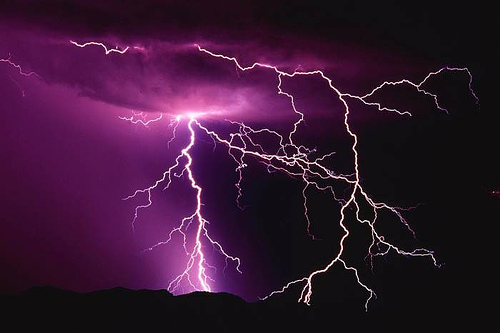
Folks, if you’ve been reading this blog for years you know I’m just nuts about grounding. Grounding is the easiest way to keep your home safe if you’re putting metal objects up on the roof. It’s also the one step that a lot of people don’t take when installing their own antennas or satellite dishes. The equipment works even if you don’t ground it and copper wire costs money. So people skip it. I get it, only… don’t do that.
What grounding does
The basic principles of grounding were discovered in the 18th century. Before that, wooden homes were at great risk of fire. Remember this was 100 years before running water came into homes and 200 years before fire extinguishers. Fire was a big deal when everything was made of wood.
The science is simple. If you run a wire from the ground up to a rod at the highest point in the house, it protects the house from static discharge. This rod is generally referred to as a “lightning rod” although that’s not completely true. If your house is hit by lightning there’s going to be damage unless you have a massive lightning rod and a super-thick cable. What a lightning rod, and proper grounding, does is make sure you’re probably not going to get hit by lightning.
Proper grounding means that any static electricity in the air has a safe place to go. It travels down the wire and dissipates harmlessly into the ground. It doesn’t build up at all. Because it doesn’t build up, it doesn’t get to the point where lightning forms. Lightning is a violent spark that happens when there is too much static electricity for the air to hold. Discharging that static electricity before it gets to that point will protect your home.
How to ground
The basics are easy. We have a document that lays out all the parts you’ll need but it boils down to three things:
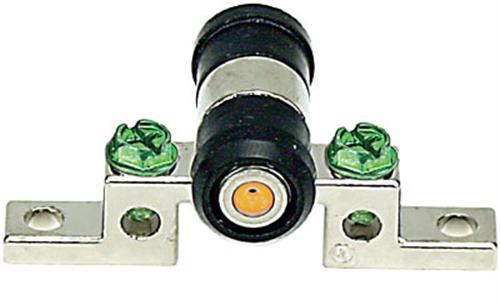
Ground block
This is nothing but a block that connects your ground wire to whatever it is you’re grounding. If your antenna has a green ground screw on it you can use that but most don’t. Most antennas will get their grounding from the coaxial cable. You connect the coax cable to a ground block and connect the ground wire to it as well.
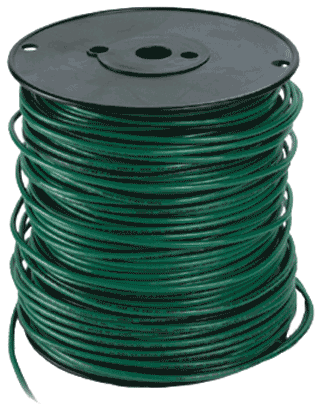
Ground wire
Ground wire is thick copper wire with a green rubber sheath. The green color lets people know it’s a ground wire. There’s nothing extremely special about ground wire compared to other wires other than it’s pretty thick and durable.
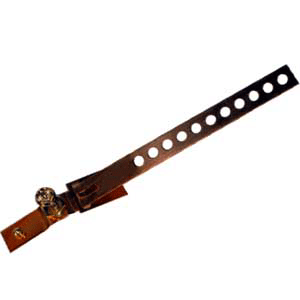
Ground strap, rod, or clamp
The other end of the ground wire is connected to something that touches the actual ground, in other words, the dirt. This can be a clamp that connects to a cold water pipe, a strap that connects to a whole house ground or breaker box, or a rod that goes straight in. Your choice of which to use depends on your local ordinances. Go to city hall and they can tell you the details.
Just connect it up… in the spring
Once it’s all connected, there isn’t anything else to do. You’re instantly protected. There’s no test to run… as long as the connections are tight then you’re safe.
However, if you live somewhere snowy, you might not be able to do this safely until the snows melt. Use some common sense. While you do want to make sure you’re properly grounded, you don’t want to fall off the roof making it happen.
For the best grounding supplies, shop SolidSignal.com!



The paragraph below is from page 6 of your grounding white paper. Where there is a “[n]” indicates a question I have that follows the paragraph.
“When grounding the mast [1], you will use 10 AWG solid copper ground wire. (You can use a #17 AWG if attached to the wire.) To start, you will want to survey the area and find the best possible grounding location. The optimal location is the ground strand coming from the electrical panel [2 & 3], you can do this using a split bolt to attach the ground wire to the strand. NEC standards no longer suggest using corner clamps or cold water spigots for grounding [4]. You can use a ground rod [5] also, but in order for that, you would need to be able to bond [6] to the electrical ground rods using a 6 AWG ground wire [7].”
1. If there’s a rotator, where do you recommend connecting – the mast that holds the antenna or the mast that holds the rotator?
2. So it’s OK for the ground wire to enter the house?
3. If yes to above, should it use the same access hole as the antenna cable? What if the panel is about 40’ away (opposite end of house in basement)?
4. What about a shallow well head made of galvanized pipe?
5. If your municipality has no code regarding home antenna grounding (like mine), how far from the house should one bury a grounding rod?
6. “Bond” – is this the same as “attach”?
7. Use a 6 AWG wire all the way from mast to ground rod instead of 10 AWG (or 17 AWG)? If yes, why and solid or stranded?
1. It should not matter which you connect to, as they should share a common metal connection in most rotators. If yours does not, then ground the rotator mast , and if possible both.
2. That depends on your local ordinances. Also in some locales the cold water line is going to be accessible from outside the house.
3. The choice of access is up to you. However if you have to travel that much in the basement, you are probably better off using a ground rod rather than entering the house.
4. Your local ordinances will dictate if you can use a well head.
5. If your local city does not have ordinances you should definitely see what the county or state has on file. If there is absolutely no code at all (unlikely) generally 10-15 feet seems sufficient.
6. “Bond” is a term meaning to attach the ground wire to a common point like a backplane which is connected to the whole building grounding system.
7. 6AWG solid should carry more excess current than thinner, stranded wire.
Thanks for the quick reply. On your response to question 7, why mention 10 AWG at all if 6 AWG is “safer”?