
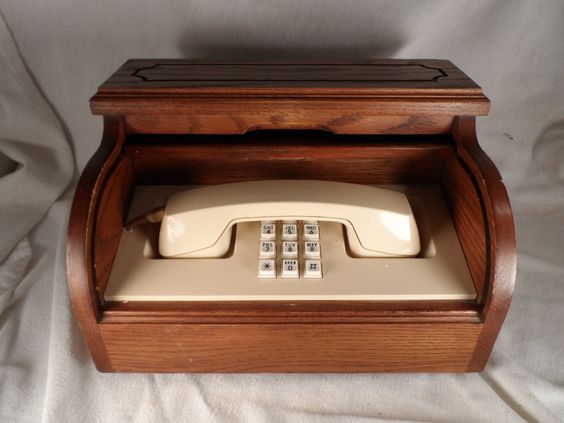
One hundred years ago, if you had a phone at all, you still had to call the operator first. Dial phones were introduced in some areas as early as 1916, but it wasn’t until 1951 that you could call outside of your city or town without calling the operator first.
Direct Distance Dialing, or long distance as most people called it, created a huge burden on the telephone systems. The old systems took a long time to dial 10 or 11 numbers (like 1-248-896-8587) and connection problems were starting to mount up.
Touch-tone service was first unveiled in 1963 and became available to New York and Los Angeles customers in 1964. The system was designed so that it wouldn’t accidentally dial a number because of music being played or people singing. By the standards of the day it was very complex, although it was incredibly simple to our computerized, jaded eyes.
A normal touch-tone phone could make a total of seven tones. The way it worked was, the user pushed a button and it made a combination of two sounds. A microphone hooked to a computer listened for the sounds and was able to decode the number. Two tones together were used because it made it harder for the computer to mistake the sound of someone singing or some background noise.
By using a grid, seven tones could make twelve different sounds.
| 1209 Hz | 1336 Hz | 1477 Hz | |
|---|---|---|---|
| 697 Hz | 1 | 2 | 3 |
| 770 Hz | 4 | 5 | 6 |
| 852 Hz | 7 | 8 | 9 |
| 941 Hz | * | 0 | # |
However, originally there were no * or # buttons.
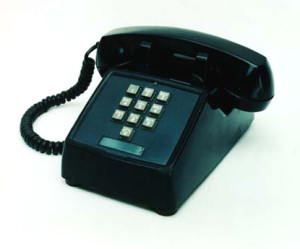
This is the first touch tone phone. Notice anything missing? No * or # buttons. They hadn’t been invented yet. They were added in 1968, but no one knew what to do with them. In fact, they were added mostly “because we can.” Since seven tones would make twelve sounds, AT&T figured they may as well put the extra buttons in, just in case someone figured out a use for them. Good thinking, AT&T.
By the 1980s, people figured out what to do with the extra buttons. AT&T introduces a series of “star codes” that let the caller do things like call back the person who had just called (*69) as well as other services. The # button became useful for a generation of voice-mail systems that proclaimed, “To finish, press pound.”
And by the way… why is it called the pound key?
In much of the world, the # symbol is called a “hash,” which will make sense to anyone who uses Twitter. Twitter, of course, makes extensive use of the # symbol for “hashtags.” In most of the world, ask for a pound symbol and you’ll see this: £ which is, of course, the symbol for the British pound.
While it’s not completely clear how # came to be known as “pound,” the most likely explanation comes in computer keyboards from the 1950s and 1960s upon which # and £ shared the same position above the number 3; international users flipped a switch to start using £ instead of #.
When people started referring to # on the touch-tone keypad, it didn’t make sense to call it the “number sign” as the keypad was made up of nothing but numbers! So, it’s pretty likely that programmers, used to seeing the “real” pound sign next to it, started calling that symbol “pound” as well.

Incredibly naive explanation of calling the # sign as “pound”. Apparently the author has never shopped much because items sold by the pound are marked as $ per #.[dollars per pound]
Direction of causality, my friend.
“The # is often called the pound symbol in the United States as it is often used with numbers related to weight. Originally “lb.” was used for this same meaning. Later, printers designed a font containing a special symbol of “lb” with a line through the verticals so that the “l” wouldn’t be mistaken as a one (℔, Unicode character U+2114). Eventually, this changed to the more familiar and easier to type on a standard keyboard “#” symbol.”
similar articles:
https://www.todayifoundout.com/index.php/2011/06/the-symbol-on-the-pound-or-number-key-is-also-called-an-octothorpe/
https://en.wikipedia.org/wiki/Pound_sign
“The symbol derives from a capital “L”, representing libra pondo, the basic unit of weight in the Roman Empire, which in turn is derived from the Latin word, libra, meaning scales or a balance…The symbol ₤ (note the double dash at its middle) was called the lira sign in Italy,”
So it seems that the shape of the # sign simply comes from its similarity of the L for ‘libra’ plus the added horizontal lines, used to differentiate it from a capital I (on a keyboard, or I suppose even in handwriting).
Your “most likely” explanation is provably false, and honestly, I’m disappointed to find that that whoever wrote this made no real effort to research the history of the number sign.
Here’s page 21 of a textbook on book keeping from 1880, listing various mercantile terms and signs, and plain as day, it describes # after a number as “pounds”.
https://archive.org/stream/bookkeepingbysin00duffrich#page/21/mode/1up
It’s a bookkeeping approximation.
The technical term used by Bell Labs for the # key was Octothorpe. Octo = 8 (the # symbol has eight points).