
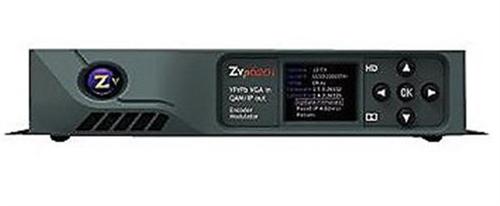
You see the thing in the picture above? Quick, is it a modulator or an encoder? These two terms are so closely linked that we use them almost interchangeably. But if you’re one of those people who’s all about precision, you know that a modulator and an encoder are not the same thing.
The English language is a very flexible thing and it’s often possible to stretch it in ways we don’t originally intend. We roll up our windows, even though you’d be hard pressed to find one car with a window crank. We dial phone numbers, even though there’s only one verifiable phone with a dial, ever. I could go on and on, although I already did, here. I even did 500 words on how “literally” doesn’t really mean “literally” anymore.
So, I’ll say right away that if you want to call a modulator an encoder, or call an encoder a modulator, that’s all right with me. But let’s define the terms and then it will be easier to understand why the confusion exists.
A modulator
Remember those red, white, and yellow RCA cables you used to use for your VCR? They carried what’s called baseband video. If you don’t feel like following the link, it’s a signal that takes up the entirety of the available space on a cable. It’s the only thing you can do with that cable. But, early on, it was discovered that you didn’t need all that bandwidth to carry a signal. You could use just one chunk of it, leaving other chunks for other video signals. (The same is true of audio signals, by the way, and the same is true of over-the-air signals as well.)
The process of taking a baseband signal and changing it so that it only takes up a small amount of bandwidth is called modulation. A device that does that is a modulator. Simple as that.
An encoder
However, a modulator by itself is pretty much useless. First of all, today’s signals are digital and you need some way to translate that analog video signal to digital. Second, who wants just video? Don’t you want audio too?
In order to put sound and pictures in the same space, you need some sort of way of putting them all together. You need some math to figure it all out and then it has to be done in a way that it can all be taken apart later. That’s what an encoder does. Today’s encoders generally use the MPEG-2 standard for video and the Dolby Digital 5.1 standard for audio, but more advanced ones can use more modern standards as well. The older MPEG-2/DD standard is used because every TV made for consumers can decode it.
So you can see…
A modulator without an encoder isn’t much use. An encoder without a modulator is a little more use, because it can be used to make digital files you can save. But when it comes to watching TV, you need both. And that’s why it’s very rare to find a modulator that isn’t also an encoder.
If you’re looking for a modulator to replace one you already have, or if you’re looking to get a whole new headend system for your business, you’ll get the best service when you call the experts! Our Signal Connect division is here to help! We’re ready to do those custom quotes and provide you with a seamless experience from beginning to end. Email us during East Coast business hours at [email protected] and let’s get started!



An Encoder encodes information, picture, sound, text, etc., in some way. Once encoded this encoded information is placed onto a carrier wave (your TV channel frequencies) using a modulator. At the TV the signal is then demodulated and this demodulated signal is then passed to the decoder to decode all that information, Picture, sound, and other info like captioning, which is then sent to the TV to watch, hear, and/or read.
Every RF (Radio Frequency, or sometimes called channel) signal today has a modulator/demodulator, not every signal has encoding/decoding because not every signal, as of today, is sent as digital (encoded) data and placed (modulated) onto a carrier wave (RF/channel).
In the US we still have modulated only signals on AM and FM radio, also some walkie-talkies like CB, FRS, GMRS, Amateur (Ham) Radio.
So the statement, “A modulator without an encoder isn’t much use.” is false, it is useful and was, for the longest time, the ONLY way to send information over radio waves (radio frequencies – RF).
However, what is true is that sending encoded information over RF is much more efficient since it can get so much more information onto the same RFs (Radio Frequencies or channel). TV today has multiple programs on the same set of TV Channel frequencies all shown at the same time. Where as before digital encoding these same frequencies (Channels) were once used for only one program at a time.
Note GMRS and Ham Radio both require FCC Licenses, and the Ham Radio license must be earned, through three tests depending on the level license you want then you have to also pay the FCC to process your license and then pay to renew the license every 10 years. With GMRS you just pay for a license. Both of these radio services can also use, send and receive, encoded, digital, data/voice/pictures. The Emergency Service of Ham Radio also uses some frequencies to send/receive video of events. Ham Radio is also an experimental platform for new ways to send information over the radio waves (RFs).