
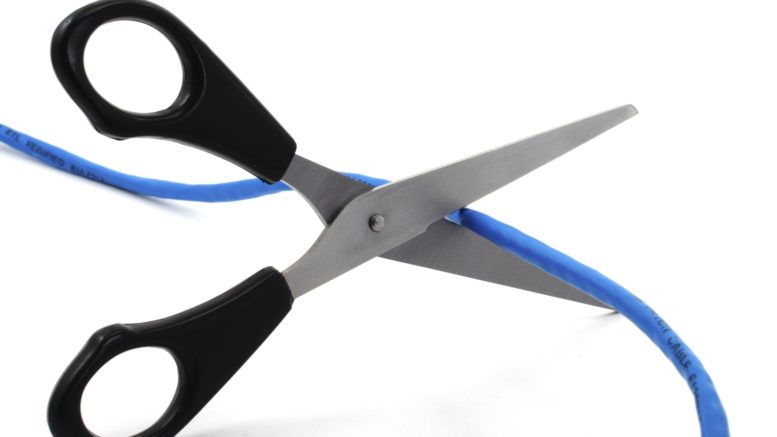
It seems like EVERYONE has an opinion on cord-cutting these days. I’m one of them, so clear the way so I can get to my soapbox.
Definitions of words aren’t set in stone. History proves that the meanings of words change according to the way people use the terms. Take “cool,” for example. Today, it could describe an ice cube or James Dean. And each definition means something different. It’s this way for A LOT of words and phrases. So, why can’t “cord-cutter” and “cord-cutting” be redefined? I think it already has.
Cord-Cutting: My Introduction
For me, this discussion starts in 2016. That’s when I first learned about cord-cutting, which coincided with me being hired at The Signal Group. Stuart Sweet was kind enough to explain what this term means and all its implications. As he said, cord-cutting is replacing cable with an over-the-air TV antenna. People who do this are called “cord-cutters.” I believe there are a few ways someone can cut the cord. I also wonder if OTA TV antenna owners have sole dominion over this title.
TV Antenna Owners with Cable Internet
Can these folks be called cord-cutters? The purists would probably shout “NO!” They’d justify their negativity by saying that anyone who pays the cable TV company for ANYTHING can’t be a cord cutter. I like to look for those sections of grey that exist between the black and the white of things. As such, I’m going to drop my very controversial opinion right here:
OTA folks with cable Internet are cord-cutters, too!
Yes, cable companies bundle TV, Internet, phone, and other services. People who buy all three (or more) are dependent upon your provider. You can cut the cord and stand on principle, but most people still need internet. (Think of all those folks who’ve been working from home!) For this and streaming, many TV antenna owners have a limited relationship with the local cable provider. They’re still cord-cutters in my book.
What About Satellite TV Customers?
The purists probably will say “no.” They’ll say satellite TV users have “traded one cord for another.” This ignores satellite TV’s benefits over cable, namely superior picture quality and programming choices. And they’re not paying the cable company for any of it. This is why I think of DIRECTV customers as cord-cutters, too. The purists can disagree all they want; I don’t care.
At the End of the Day…
…Cutting the cord is more than just “sticking it to the man.” The revolution is all about finding the best and most affordable services for you and your family. Wages have been staying stagnant across most sectors, but the cost of living is skyrocketing. This forces families to stretch each dollar. Cord-cutting, in whatever form, becomes an economical solution for many. It’s all about that value, which is why cord cutting is here to stay… and why there are more cord-cutters than you think!


Jake,
I have no idea who ever told you that chord cutting had anything to do with the Internet, it does not. Your “redefinition” is the original definition, at least from my perspective.
Cord cutting only has to do with getting your TV via OTA or via cable. I am a believer that satellite TV is the same as a cable provider for TV, you are paying someone for your regular OTA TV station programming (plus a whole host of stuff you probably don’t want anyway.)
IMHO Anything you can get OTA coming to you via cable/satellite should be free, except for a very small connection fee and box rental. Now, if you get the Internet then it’s completely free because the connection fee is part of the Internet service anyway. Box rental or purchase, if possible, is still allowed unless your TV can decode the cable or satellite signals.
Basic cable service should be:
Internet + all local OTA stations. Or at lest the stations from the closest major city.
Basic Satellite service should be:
All local OTA stations – this includes the antenna, cables, and decoder box.
Why should these stations be free? Because the OTA TV providers are already being paid through advertising. The only problem I see is that the cable & sat providers don’t want to do the work to tell the local stations how many people are watching their programming so they can charge their advertisers. It’s much easier for them to charge you to watch OTA TV than figure out who’s watching what when.
That’s it from me, and like you I’m sure many will disagree with me as well.
Phil/KE3FL
The US is by far the country that has the best OTA TV offer in the world and the least utilized. Too many many people hooked on cable. Total waste!