
We call it “standard definition” but until pretty recently we just called it “television.” I’m talking about the square, possibly wood-grained television of your youth.
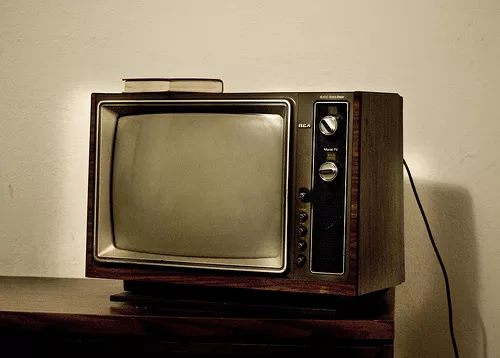
Yeah, this.
This is how we watched television for about 60 years, and it’s only been since the mid-2000s that our TVs have gotten sleek and slim and gorgeous. Unless of course you’re in a hotel, in which case you’re probably still watching TV “old-school.”
Oh, there might be a flat TV in the room, since tube TVs like the one above are pretty hard to find. But the dim, blurry picture on it may look like it belongs on a tube TV, and that’s because it does.
How TV gets to a hotel room
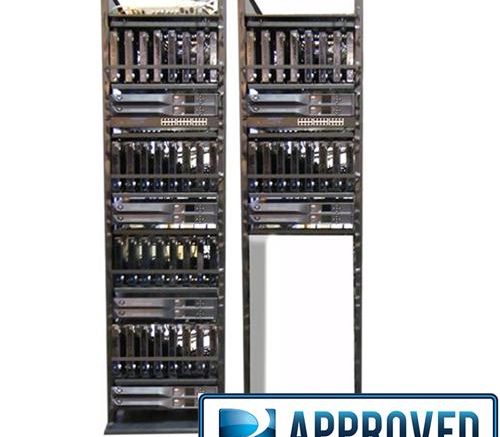
Most hotels have a rack of cable or satellite receivers and other equipment that provides live TV to the guest rooms. If you’ve ever worked at a hotel you’ve probably seen it. This is called a “headend” and it’s the way that hotels, large buildings, hospitals and other institutions distribute TV signals.
Headends are less expensive and more efficient than trying to put a cable or satellite box in every room. They are a lot easier to wire too. That’s why they’re used so extensively. However, you have a lot of choices to make when you’re building a headend system. One is how many channels to offer. Every channel costs money; the more channels, the more money. Another is standard definition or high definition.
Why choose high definition?
High definition headends give each room a signal that’s basically identical to what the guest sees at home. The quality level is great, the colors are nice and pure and it’s a joy to watch. It’s TV the way that people in 2018 expect to watch it.
A standard definiton headend won’t give the guest the same experience. Sure, oldtimers will say “no one goes to a hotel to watch TV” but we all like to relax when the day is done and often times the TV is the right way to do that.
Which to choose?
A lot of times, a standard definition headend will be a little cheaper. Not much, mind you. It used to be that SD headends were about half the price of HD headends. Today that’s not true. There is a small charge to get you up to HD but it’s usually in the single digit percentages.
Personally I think it’s time that we move away from standard definition headends. The hardware is going to be around for a while because you’ll need replacement parts of those older headends. However, if you’re buying a new headend, I really think you should be looking HD. I wouldn’t worry about 4K at this point, there still isn’t any content out there for it. However I would definitely be putting in the extra money to go HD, because it’s just not that much more and it’s worth it. Even if you have to cut out one or two channels I think it would be worth it to be able to show all the channels in HD.
Here’s how you get started
If you’re looking to upgrade a hotel or other institutional business you can call the excellent folks over at Signal Connect, the corporate arm of Solid Signal. They are experts in helping people just like you figure out the best solutions for television, cell phone service, and all the other forms of technology that are impossible to avoid today. The number is [email protected]. We’re here for you during East Coast business hours. If it’s afer hours, fill out the form below. We’ll get right back to you.




Hello Stuart Sweet,
A long time ago we started using an analog headend system. The system was rack mounted holding up to 16 standard definition modulators/demodulators. Some of our racks had dual power supplies. Each individual rack had the outputs sent to a combiner just under the 16 mods/demods. Since we used multiple groups of 16 mods/demods we cascaded the outputs from each combiner until all the signals would go out to the tv’s. We used 4 output splitters (1×4) which we then used to send the signals to the tv’s. We used different fixed db values at the tv’s as we needed to get the level of all the tv’s as close to 10 db as possible. The last output of each individual splitter was used as the input of the next splitter. Some locations had 70 or more tv’s so it was important to balance the inputs to the tv’s in every location. Occasionally we would get an adjustable mod/demod that could be changed to any channel as some of the mods were difficult to come by as we needed them immediately if not sooner. They were different as they needed two of the 16 spaces in the rack. The later ones had a digital display for the channel number. I can’t remember if there were two buttons for channel up/channel down, a screwdriver turning up or down channel or there was a knob that you would turn in the direction that you wanted to go to the proper channel. Thanks for making me go on a journey down memory lane.
Yours,
caseyf5