
This article incorporates new content from reader comments.
Without a doubt, North America is the biggest paid satellite TV market. DIRECTV alone counts 24 million subscribers. However, if you were to look at all of Europe’s satellite services, it’s probably a bigger market than that. It’s impossible to know, though.
Most of Europe’s satellite TV services are free!
That’s right, most people in Europe can put up a satellite dish and get free TV, just like we do with antennas here in the US. There are paid services like SKY that offer a more DIRECTV-like experience for a fee, but if you’re in most European countries you can just put that satellite up and get several channels of live TV.
European countries can get away with this, and we can’t here in the US. In European countries, most TV broadcasting is either state-run or state-sponsored (much like PBS is here.) In Europe, there aren’t “network affiliates” that claim exclusive rights to their regions. Network programming is more national.
In fact, most European countries have moved to satellite for national programming instead of trying to cover the whole country with traditional TV broadcasts. It’s more economical to operate one satellite than a whole bunch of small towers. Large metropolitan areas still have broadcast TV, but in smaller areas, it just makes sense to go satellite only.
European satellite technology is mostly the same as…
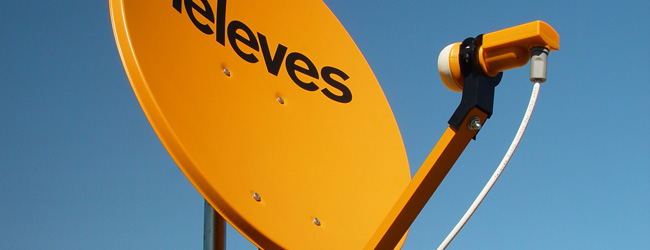
The satellite services used in Europe are very similar to what we had here in the US twenty years ago. In order to get satellite TV you put up a relatively small round dish with one LNB. You connect it to a satellite receiver and that’s about it. There aren’t really multi-satellite services, because they aren’t needed. Without thousands of local channels to worry about, most broadcasts fit on one satellite per country. There are some countries that use two satellites, but the US is the only country to ever have had seven active satellite locations.
There are two types of LNBs used in Europe, though. Different satellites encode their signals differently. Most satellite broadcasting in the US uses “circular polarization,” meaning the signal travels like a corkscrew. This makes the signal easier to get without super-precise aiming. European satellites still use “horizontal polarization” which means the waves travel left and right through the air.
DIRECTV and DISH have evolved
DIRECTV has the exclusive license for satellite TV broadcasting in the 25-40GHz band, known as the “Ka band.” No one else uses these frequencies for satellite TV in North America, although some countries in Europe use it. This is the number one reason that you can’t use a regular European satellite dish here.
Both DIRECTV and DISH use multiple satellites, and since no one in Europe does this you would have to use multiple dishes instead.
On the DISH side, they have started to move to the Hybrid LNB which is designed specifically to feed the Hopper 3, Wally, and Joey equipment. This one LNB makes it possible for Hopper 3 to provide 16 tuner-recording and it’s completely incompatible with standard European equipment.
What you need to know if you’re a boat owner
About 99% of people with satellite service in the world are able to put up a dish and not worry about service from other countries. Who are the 1%? Boat owners, of course. If you travel from country to country you’ll want to be able to use satellite TV service everywhere. Luckily, Intellian and KVH offer products that work both with US services like DIRECTV and DISH and services in other countries. Generally you can choose a system that will work pretty much anywhere in the Western Hemisphere, or if you’re planning to take a long trip you can get a system that works anywhere in the world. It’s smart to plan ahead, though, since upgrading a dish generally equates to replacing it.
If you do travel from country to country, you’ll need to contact a dealer in that country to establish service. As much as we at Signal Connect would like to help you, it’s not something we can do.
Using a generic satellite dish for HD or 4K
There’s a misconception, though, that you can’t use a round dish for HD or 4K. This isn’t true and there’s plenty of HD programming overseas that uses a round dish. However in the US, the satellite providers have put HD on one satellite and SD on another. This requires a multi-satellite oval dish. There are a handful of HD channels on DIRECTV’s satellite at the 101 location but not too many of them.
So there is a chance that you could use a Euro-spec dish here in the US, but it’s not a very good one. You would be limited to only the non-Ka-band broadcasts on one satellite at a time. This could mean you see only a few channels, and depending on your satellite provider you might get SD only.
If you’d like to know more about how satellite equipment from all over the world can be used here in the US, call us at Signal Connect, at [email protected]. If it’s after hours, fill out the form below and we’ll happily call you back!




Some other details from an European resident.
– There is no more circular polarization here in Europe from like 20 years. Last satellite that used it was Hispasat at 30°W ’cause had (and has) a footprint also on USA.
– Some countries share the services on 2 satellites, with 2 LNB no problem also on circular dishes ( I actually have 4 LNB on mine)
– Local channels now are on separated satellites sometimes (ex. Italy, nationals on 13°East and Locals on 9°East).
– A lot of channels are scrambled, but they can be opened in the country of residence according with the tv stations rights using a smart card without subscription (Ex. Fransat, Tivusat, HD+, Austria digital, etc..) this due the fact that many stations broadcast movies and series in double language (often english) and someone over the British channel (the one made of water 🙂 ) complained in past. Note also that now every country has like 99% of channels in HD and even in 4K (like for example, italian RAI or german RTL) and public channels usually have the rights for big sport events. Tv have the integrated tuner both for satellite and digital terrestrial (that has the same channels but from local transmitters)
– Aerial broadcast still up to 99% of territory in any european country, satellite is mostly used as backup or to carry more quality (like HD or 4K). On terrestrial the standard widely used is DVB-T2
– Ka frequencies are used almost only by Irish tv, with the Saorview transponder and Ka signals extend only for a hundred miles (cells coverage).